
What If the Gates of Heaven Were Never Above Us?
Aug 04, 2026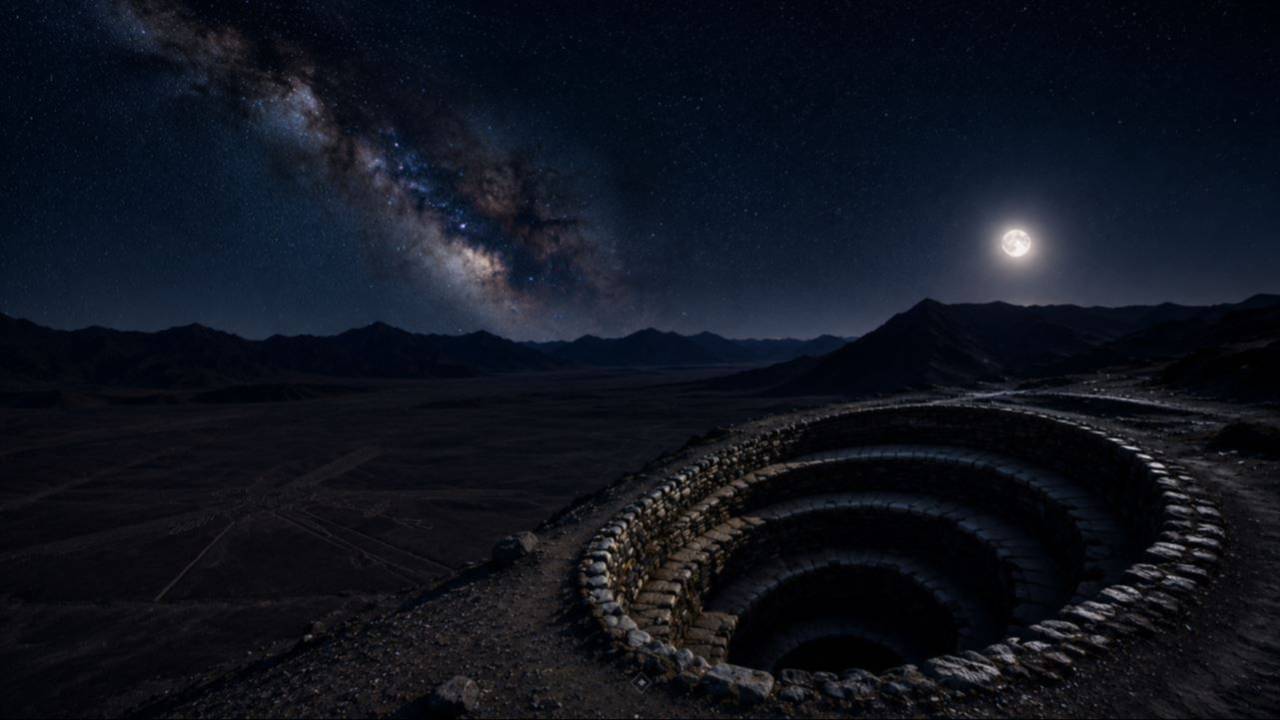
The Puquios of Nazca, Intelligence That Travels Through Time, and the Solutions We May Not Yet Have Learned to Recognize.
Alejandro brought the dream.
He works with us, and it happened during one of those stretches when deadlines compress and the nights run long. When you turn off the light but the mind keeps working, and the body falls asleep before the questions do. We weren't talking about archaeology. We weren't talking about Peru. Nazca was part of no conversation and no project. If anyone had asked us a few days earlier, we could not have said much beyond the name.
That night he dreamt he was walking through a forest.
Not a desert. Trees. Shade. The most unlike place possible to the one the song was about to name.
At some point, Sisters appeared. They did not speak to him. They sang. And all they repeated was a single line.
"The gates of heaven are open on the shores of Nazca."
He mentioned it the next morning without ceremony. He made no attempt to interpret it. He made no attempt to convince anyone it meant something. He simply put it on the table.
He brought no explanation. He brought no conclusion.
He brought a direction.
And I decided to follow it.
I was not looking for proof in the dream. Dreams do not establish facts. But I have spent my life receiving them this way, and depth psychology has spent more than a century treating them as what they are: material from the unconscious, one's own and also the shared one, ordering at night what waking hours have not yet managed to order.
A dream does not give answers. It gives directions.
And over the years I have found that the best investigations almost never begin with an answer. They begin with a thread fine enough that anyone would let it go, and with the decision not to.
Most people look for answers. I have learned to look for traces.
A choir of nuns announcing the gates of heaven is, more or less, the most celestial image a dream can offer. Everything in it points upward.
And yet, when I began looking into Nazca, something curious happened. The gaze changed direction.
Not up.
Down.
What Lies Underneath
When we think of Nazca, most of us picture the lines. The enormous figures drawn across the desert, visible from the air, surrounded for decades by theories about lost civilizations and visitors from elsewhere.
It's worth pausing on that disproportion. The lines have generated a century of hypotheses: astronomy, ritual, calendar, signals meant for someone. And they are real. Enormous, precise, impossible to ignore. That is exactly why they work so well as a distraction. A lie doesn't pull attention half as effectively as a spectacular truth.
There is no need to take sides in that debate. Grant whatever origin you prefer. A question would still be left standing, and almost no one asks it.
Because a work is not explained by whoever began it. Beneath that same ground lies another one. Far less photographed. And perhaps for that reason, far more revealing.
The Puquios.
To understand what they are, you first have to understand where they are. The Río Grande de Nazca basin is one of the most arid territories on the planet. The rivers that cross it are seasonal: they run for a few weeks a year, and the rest of the time their beds are dry stone under the sun. But the water does not disappear. It keeps moving beneath the surface, filtered through sediment, invisible from above.
The builders of the Puquios did not look for water in the sky. They went to find it there.
The system has three parts.
First, the filtration galleries: tunnels dug below the water table, sometimes several meters down, that intercept the groundwater and carry it. Their walls are lined with river cobbles laid without mortar, wedged one against another. That loose stone is not a finish. It is the filter. Water enters through the joints and leaves its sediment behind. The roofs were covered with stone slabs or with huarango logs, the hard wood of the desert.
Second, the ojos, the eyes: shafts open at the surface that spiral down to the gallery, with ramps or steps set into the wall. Seen from above they look like funnels cut into the sand, and they are the image that made the system famous. Their documented function is constructive and practical. The tunnel was dug through them. Through them someone goes down to clear accumulated sediment, repair a collapsed stretch, check the condition of the stone. It has also been proposed that the open form encouraged air circulation, though that remains a hypothesis and is worth saying so.
Third, the outlet: the water surfaces into open channels and into cochas, reservoirs where it gathers before being distributed to the fields.
The entire route runs on gravity. No pumps, no motors. Only a gradient calculated with enough precision that the water moves on its own for kilometers.
And there is a detail that tends to go unnoticed. Traveling underground, the water does not evaporate. In a desert where an open canal would lose much of its flow before reaching the fields, the system solved the problem of loss long before the word efficiency existed.
Thirty-six puquios are still running today, spread across the Nazca, Taruga, and Las Trancas valleys. Twenty-nine in the first. Five in Las Trancas. Two in Taruga. In the past there may have been more than fifty.
Thirty-six systems.
Not as museum pieces. As working irrigation infrastructure, fifteen centuries on.
A Necessary Honesty
It is worth saying what we don't know.
The pre-Hispanic attribution is strong and widely accepted, but the exact dating and the history of later modifications remain matters of academic debate. There were colonial and republican interventions on several stretches. Some researchers have proposed outside influences on the design.
That debate doesn't need to be settled for the point to hold. And the Puquios don't need to be exaggerated in order to be extraordinary. What is verifiable is enough: a hydraulic system built from stone, wood, and calculation, in one of the driest deserts on earth, still delivering water fifteen centuries later.
Monuments and Systems
Now the question can be asked.
Why do we keep looking to the sky for answers while beneath our feet there are works capable of sustaining life for centuries?
Perhaps we have learned to admire monuments and stopped observing systems.
Monuments ask to be admired.
Systems exist to sustain life.
The Nazca lines are seen from the air and have spent a century generating literature. The Puquios are understood from the inside and have spent fifteen centuries generating harvests.
What Makes Continuation Possible
There is something in the design of the Puquios that deserves separate attention, because it has nothing to do with water.
The continuity of a system does not depend only on the quality of its original design. It depends on other people being able to enter it, understand it, clean it, repair it, and adapt it without destroying the principle that keeps it alive.
The ojos served that purpose. They gave access to the invisible.
A fully sealed system would have hidden its faults until the day it stopped working. An accessible one could be observed, maintained, and corrected before collapse. And maintenance was never an individual task: clearing the galleries required sustained community organization, generation after generation, long after the people who dug them had died.
Here the question left open earlier comes back.
The water kept flowing for centuries because someone went down every year to clear the sediment. Because someone showed someone else where the weak stretch was. Because a community organized that work long after the builders had ceased to exist.
That part of the story has no famous author. And it is the only part that explains why the system still works.
When the most complete study of the puquios was published in 1995, two people signed it: an archaeologist from a university in California, and a man whose mailing address was a street in Nazca. Nine years earlier, that man had already written a report on the subject. Not on the mystery of the aqueducts. On their maintenance and rehabilitation problems.
While some look up, someone has to go down.
Perhaps that is why the Puquios are not only about water.
They are about memory turned into architecture.
Whoever Builds
There is a decision inside that work that deserves naming.
Someone had to choose the gradient. Not any gradient: the exact one. Steep enough for the water to move on its own for kilometers, shallow enough that it would not drag along the sediment that would clog the gallery. That calculation is not made with force. It is made with a very still attention, held over a long time, on a territory that offered no obvious sign.
From what state does someone calculate like that? We don't know. We know that whoever did it spent a long time listening to a place before touching it.
Whoever builds is choosing, among infinite possible forms, the one that will hold. It is the oldest operation there is. And it is the same one at every scale: a channel, a building, a company, a life.
That is why a work always reveals something about the person who made it. Not their technique. Their way of looking.
A company can accumulate twenty years of experience and still wake up every morning as if it were its first day.
It happens when its intelligence stays locked in the memory of particular people. When decisions keep the outcome but lose the reasoning. When each generation has to rediscover what the last one already learned, and no one knows where it was written down, if it ever was.
That organization has no ojos, no eyes. No one can go down and see the condition of the system. Faults are discovered when the water stops coming out.
Preserving intelligence does not mean preventing it from changing. It means building the access points that let others enter it, understand it, and keep developing it.
Perhaps civilizations suffer the same amnesia. Perhaps a culture's greatest error is not forgetting a technology, but forgetting the way of thinking that made it possible.
The engineers of Nazca did not fight the desert. They learned its language. They did not try to impose water where there was none: they found how to work with what the territory already offered.
Their real legacy was not the channels.
It was a way of thinking.
Time and Intelligence
We speak of time as though it were a straight line. Past, present, future.
But intelligence seems to move differently.
There is knowledge born in one era that waits for another to be seen. There are principles that stay silent until a generation develops the tools, or the sensibility, to recognize them.
We assume knowledge travels forward. What if it also reaches us from directions we haven't yet learned to name?
Bioclimatic architecture reappears in contemporary buildings. Biomimicry studies ancient organisms to design new materials. Artificial intelligence is beginning to help us recognize relationships that stayed scattered for centuries across disciplines that never spoke to one another.
Perhaps the deepest innovation is not only to create.
Perhaps it is also to remember.
But remembering is not going backward. It means recovering an intelligence, understanding it through the consciousness of our own time, and giving it a form capable of serving the future.
That is a profoundly creative act. We do not repeat. We do not imitate. We continue.
What Our Time Might Remember
What could we learn from systems that captured and carried water without separating the infrastructure from the territory it was meant to sustain?
How would our cities, our buildings, and our data centers change if climate stopped being seen only as a force to fight and began to take part in the design?
And what kind of projects would we finance if value included not only immediate return, but durability, adaptability, and the capacity to keep serving when conditions change?
I went back to the line from the dream:
"The gates of heaven are open on the shores of Nazca."
At first it seemed to point upward. Now I hear it differently.
Perhaps the gates of heaven never pointed to a way out of this world. Perhaps they pointed to an act of consciousness. The decision to observe so closely that the desert reveals where it keeps its water.
Because that is what happened here. Someone looked down, learned the language of a territory that seemed to deny everything, and opened by hand a set of stone funnels through which water rises.
Bringing heaven down to earth was never a figure of speech. It was labor, calculation, and a way of staying awake.
The scale changes. The principle does not.
And perhaps the gates of heaven were never above us.
Myriam V.
GET THE FREE GUIDE
Lorem ipsum dolor sit amet, consectetur adipiscing elit. Cras sed sapien quam. Sed dapibus est id enim facilisis, at posuere turpis adipiscing. Quisque sit amet dui dui.