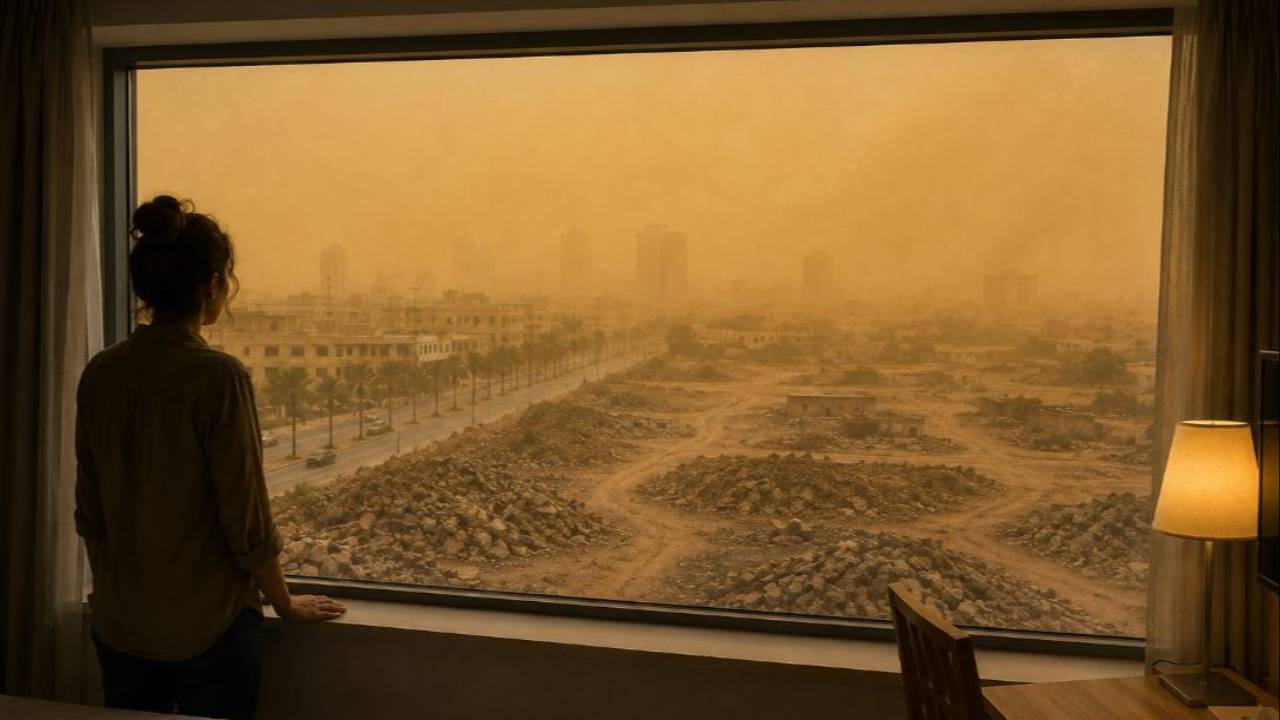
A window in Cairo, the archaeology of the soul, and the moment I understood why every great construction begins by looking like a demolition.
"Every construction site, seen without the plans, looks like a demolition."
I. The Journey Had Begun Long Before the Flight
There are journeys that begin when the plane takes off.
And there are others that begin long before.
They begin when a sentence enters us and stays there in silence, waiting for the moment life will give it meaning.
Before we traveled to Egypt, Luis Jiménez gathered the group.
He didn't talk about the itinerary.
He didn't talk about the pyramids.
He didn't talk about the temples, the museums, or the history.
He looked at us with a calm I can still remember and said something that, at the time, none of us fully understood.
"Say goodbye to your loved ones.
Hold them tight.
Because, literally and symbolically, you are going to be reborn.
The versions of yourselves you know today will be left behind before you return from this trip."
There was a strange silence.
It wasn't fear.
It was something harder to name.
We all understood the words.
None of us understood the experience hidden inside them.
Because language always arrives before comprehension.
And there are truths that can only be learned by living them.
Today I believe a rebirth doesn't begin when a new version of us appears.
It begins when the previous one can no longer sustain the life that is trying to be born.
And almost always…
that moment doesn't look like a birth.
It looks like a demolition.
II. The Noise
We had left Miami.
A layover in Rome.
And then the last leg into Cairo.
Airports.
Waiting.
Lines.
Sleeping in pieces, sitting up, head against a window.
Drinking water and still being thirsty.
Losing all sense of what time it was where we were and what time it was where we had come from.
By the time we finally arrived, my body knew nothing.
That's what no one explains about a trip like that: you don't arrive tired, you arrive with no defenses.
Without the layers a person normally uses for protection.
Thinner skin.
Everything gets in without asking.
There are states in life where we no longer have the energy to hold up the presentable version of ourselves.
Or to pretend everything is fine.
The trip had left me exactly there.
And I think that's why I was able to see what I saw.
The hotel was the Novotel by the airport.
A place built for transit.
A place you pass through.
The itinerary said it would be a single night of passage.
We would arrive, meet the group at the opening dinner, and before dawn, at four forty-five in the morning, we would head out again toward Aswan.
But places of passage have a strange way of turning into thresholds.
Before the first temple, before the Nile, before any ceremony, Egypt was already teaching us how to look.
Anna was already there.
Smoking.
Pacing back and forth.
She looked exhausted.
She hadn't slept all night.
She was trying to smile, but something in her body was still on alert.
She told us that from her window all she could see was a demolition.
And when I saw it later with my own eyes, I understood why she hadn't been able to sleep.
There were no machines working.
There were no workers.
That was the first thing that surprised me.
What remained was the aftermath.
Piles of broken concrete, gray, spread across a lot someone had already cleared.
Stone on stone on stone.
And farther back, the far end of the site had already been graded.
Clean.
Ready.
Both things fit inside the same window: what had come down, and the ground waiting.
No one had placed them together so that anyone would understand something.
They were simply there.
The air had the dry taste of dust that never quite settles.
It wasn't only dust.
It was the sense that something which had held up a structure for years had just stopped existing.
The sky wasn't blue or gray.
It was yellow.
The sandstorm hadn't ended, and it covered everything: the buildings in the distance, the palm trees along the avenue, the light coming into the room.
It wasn't fog.
It was airborne dust, and it gave every surface the tone of old amber.
There were moments when the background disappeared completely for a few seconds.
I thought that must be what a life feels like when its certainties begin to fall.
For a while we can't see clearly.
Not because the road has disappeared.
But because there is still too much dust hanging in the air.
The sound didn't come from the site either.
It came from the sky.
Every so often a plane took off and the glass vibrated a little.
And then again that wide silence of ground where there is nothing left to bring down.
As if the city were breathing while it changed shape.
As if that weren't enough, a baby had cried all night long.
Every time Anna was about to fall asleep, the crying came back.
By dawn it wasn't only fatigue anymore.
It was depletion.
When she saw us, she wanted to protect us.
She insisted.
"Ask for another room."
"Don't stay in that wing."
"I don't want you to go through the same thing."
There was love in her insistence.
And there was also an interpretation.
To her, that view was bad news.
And she wanted to spare us.
We went to the front desk.
We asked.
The answer came immediately.
The hotel was completely full.
There was no other room.
There was no other wing.
There was no other view.
Life, sometimes, doesn't offer us another window.
It invites us to learn to look from the one we already have.
III. Opening the Curtain
Room 3101.
We went in.
Anna came in behind us.
She wanted to see which view we had been given.
I remember walking to the far end of the room.
Taking the curtain.
Opening it.
And feeling something happen inside me before I even had time to think it.
My eyes began to fill with light.
A chill ran through my whole body.
It wasn't an idea.
It was a physical certainty.
As if my body had recognized something before my mind did.
The glass wasn't even clean.
It had dust on the outside, spattered, like every pane of glass in that city.
And still.
I turned toward them.
And said, almost without breathing:
"Girls, come see this!"
Anna looked at me from the other end of the room, completely puzzled.
For a moment she thought our room faced somewhere else.
As if we had been lucky enough to get a different view.
She walked to the window.
She looked.
It was exactly the same.
The same rubble.
The same dust.
The same open ground.
The same demolition.
Nothing had changed.
Except one thing.
The way we were looking at it.
IV. Two People Can Look at the Same Landscape and Live in Different Worlds
I have never forgotten that instant.
Because that's where I understood something I couldn't explain for years.
The objective reality was identical for both of us.
But the experience was completely different.
She saw the end of a structure.
I saw the beginning of another.
She saw what had been destroyed.
I saw the space where something could finally be built.
She saw loss.
I saw possibility.
She saw dust.
I saw ground capable of carrying something that didn't exist yet.
And I want to stop here.
Because this point matters.
I don't think Anna was wrong.
And I don't think I had superior vision.
We were both telling the truth.
We were simply looking at different moments of the same process.
She was still inhabiting the grief.
I was already seeing the architecture.
Not everyone arrives at a demolition at the same moment.
Some arrive while everything is coming down.
Others arrive when the foundations begin to show.
Neither is wrong.
They simply inhabit different places of the same birth.
V. What an Excavation Looks Like to Someone Who Hasn't Seen the Plans
There's a reason a construction site usually looks chaotic to us.
Because we can't yet see the thing being built.
We only see what stopped existing.
We see open walls.
Pipes.
Steel.
Dust.
Stacked material.
Noise.
Interruptions.
Voids.
But whoever designed the work doesn't see chaos.
They see the sequence.
They see order.
They see stages.
They see processes that haven't finished yet.
And maybe that's one of the great difficulties of a life.
Learning to stay on the site while all you can see is rubble.
Because the culture we live in taught us to value finished buildings.
Ribbon cuttings.
Perfect photographs.
Results.
Applause.
But it almost never teaches us to honor the time of the demolition.
The uncomfortable time.
The time when nothing seems to make sense.
The time when we are no longer who we were…
…but we don't yet know who we are becoming.
And still, every true work passes through that territory.
There is no architecture without excavation.
There are no foundations without first breaking open the ground.
There is no birth without an earlier structure becoming unable to hold what is trying to emerge.
VI. The City Is Made of Layers
Egypt taught me something no book had been able to explain.
There is no virgin ground there.
Beneath every temple there is another temple.
Beneath every city there is another city.
What is walked on today as a street was once the roof of something.
And what is admired today as a monument was, in its time, a noisy construction site filled with scaffolding and unfinished stone.
Nothing that seems sacred to us now was born finished.
And that's when I began to understand the difference between two trades that look very much alike from the outside.
The one who demolishes removes because he wants something to disappear.
The archaeologist removes because he wants something to appear.
Both move earth.
Both leave dust in the air.
Both, seen from a window, look exactly the same.
The difference isn't in the gesture.
It's in the intention.
And in whether someone knows what lies underneath.
To excavate is not to destroy.
To excavate is to remove what accumulated on top.
VII. Archaeology of the Soul
Years later I understood what I had recognized that morning from the window.
I wasn't looking at a job site in Cairo.
I was looking at the map of what was about to happen to me.
In 2022 I began a passage.
It wasn't a course.
It wasn't a phase.
It was a search for a depth you don't reach by reading.
And that's where the real work began: the inherited patterns, the invisible loyalties, the stories I had been repeating believing they were mine.
The circle got smaller.
My tastes changed.
My language changed.
My loyalties changed.
One life ended.
And another version of me was born.
From the outside, that has a short and unfortunate name.
You've changed.
You've lost your way.
You're not who you used to be.
And it's true. I'm not who I was.
But I didn't lose my way.
I was in the excavation.
And there is an image that has ordered everything I know about this ever since:
Someone looking at an excavation from the outside doesn't see an excavation.
They see wrecked ground and pieces scattered everywhere.
They don't see the method. They don't see the map. They don't see what has already been recovered.
They see disorder.
What is archaeology of the soul to one person
may look like rubble to those watching from above.
And it isn't anyone's fault.
No one can read a set of plans they were never shown.
Much later I would understand that window had been my first puquio.
I didn't know to call it that yet.
VIII. What Comes Up When the Ground Is Moved
And here is what no one warns you about before you begin.
That you don't know what will come up.
An archaeologist opens a layer with no certainty of what's underneath.
There may be a floor.
There may be a tomb.
There may be a vessel broken into forty pieces.
There may be nothing, and that is information too.
The excavation of the soul works the same way.
Sometimes a rotten root comes up.
Something that had been decomposing for years just below the ground you walked on every day: an inherited loyalty, a fear that wasn't even yours, an agreement you made at seven years old and never revisited.
That is not pleasant to pull out.
It smells.
And it is exactly what was poisoning the soil where you kept trying to plant.
Sometimes what comes up is debris that's good for nothing, and you have to learn to let it go without ceremony, without writing it a farewell, without turning it into a story.
Sometimes a whole vessel comes up. An intact memory. A piece of your life better preserved than you feared.
And sometimes a gift comes up.
That is the part that can't be anticipated, or forced, or earned.
Something that was yours so long ago that you no longer remembered having it.
Gifts asleep for eons.
Capacities you didn't learn in this life and yet recognize the instant you touch them, the way you recognize a house you lived in as a child.
Bringing that to the surface is the most intense thing I've ever done.
They don't come up clean.
They come up with soil on them, with the wound attached, with the reason they were buried in the first place.
And you have to hold them long enough to clean them before you can use them.
And there's one more thing, the one that changes the meaning of all of it.
While you're excavating, you're already building.
They aren't two separate stages.
The same hand that removes is the one deciding what stays.
Every layer you clear is a decision about the foundation.
You dig before the plan is visible.
The plan reveals itself in the digging.
IX. There Were Days When I Saw Rubble Too
For a long time I thought I was losing myself.
Not because I had stopped believing in myself.
But because the references I had learned to recognize myself by no longer worked.
What used to make me feel successful started to feel small.
Conversations I used to enjoy stopped feeding me.
Some relationships changed places.
Some people thought I had pulled away.
And maybe they were right.
Except I wasn't pulling away from them.
I was getting closer to a part of me that had spent many years buried under layers of adaptation.
It wasn't comfortable.
There were days when I looked at my own life and saw exactly what Anna saw from that window.
Rubble.
Days when I had no proof that a plan existed.
And, if I'm being completely honest, days when I wished none of this had ever started.
Days when the only thing holding up the work was that I kept working.
Certainty doesn't come first.
It comes after.
What comes first is only the decision not to abandon the site.
X. Percent Complete
In construction, a job isn't measured only by what can be seen.
It's measured by the stage it's in.
A project can have months of work behind it and still, from the sidewalk, look like an empty lot.
Engineering. Permits. Studies. Procurement. Excavation. Foundations. Everything that goes underground.
And still someone can walk past and think nothing has started there.
It started a long time ago.
It's just that almost everything built is still below the surface.
That's why a job is also valued by its percent complete.
It isn't paid only at the end.
The value of what has been executed is recognized stage by stage, as each part gets put in place.
There is work that shows.
And there is work that, once covered, no one will ever look at again.
Both get billed.
Both hold the building up.
And there's a rule that's even more exact.
No stage can be covered before it's been inspected.
The steel is checked before the concrete goes in.
The pipes are tested before the wall is closed.
Because if someone covers it too soon, the error stays inside.
And a long time can pass before anyone finds it: usually when something that depended on it is already failing.
The same thing happens to us.
There are wounds that didn't go away.
They were covered quickly.
That's why excavation doesn't exist only to remove.
It exists to allow inspection.
What isn't inspected doesn't disappear when it's covered.
It only becomes harder to reach.
And then I think of the impatience with which we measure our own transformations.
We want the façade while we're still compacting the soil.
We want clarity when we've only just cleared away what was blocking the view.
We want to show results while we're still installing, inside ourselves, systems that haven't been tested under load.
And because we don't look finished, we conclude we haven't moved.
No one walks onto a job at the foundation stage and asks why the cabinets aren't in yet.
To ourselves we do it every day.
There's something else, which took me a while to understand.
Not every project has the same scope.
Some people are raising a tower: deep excavation, long calculations, years before the building reaches its height.
And some people are building a cabin in the woods. Small. Quiet. Made to hold a different kind of life.
A cabin is not an unfinished skyscraper.
A skyscraper is not an exaggerated cabin.
Every project answers to a site, to a load, to a function.
Some build to gather crowds.
Others build to shelter a single life.
Some raise height.
Others carry water.
Some restore what time damaged.
No function is small when it serves the whole with integrity.
We're the same.
We didn't all come to raise the same thing, and we don't all need the same depth of foundation.
And that diminishes no one: it's what makes a city possible.
Someone designs.
Someone calculates.
Someone excavates.
Someone installs.
Someone takes care of the details nobody notices until they're missing.
None of those hands could finish the work alone.
That's why patience isn't passivity.
It's respect for sequence.
Patience isn't waiting for the work to be over.
It's recognizing the value of each stage before the whole thing is visible.
I don't need to look finished to know I'm moving forward.
I don't need to see the whole building to honor what is already holding it up.
Peace doesn't arrive when the work is done.
It arrives the day we learn to trust the process while we're still standing in rubble.
XI. What Looks Like Absence
There's something it took me years to name without it sounding like an excuse.
When someone is in excavation, they stop being available the way they used to be.
Not because they left.
But because they're down there.
Deep work has a cost that almost never gets counted: it costs body, it costs silence, it costs linear time.
You go down to recover something that fell asleep.
You go down to disarm a wound that's still collecting a toll.
And then you have to come up, and integrate, and go back down again.
Down and up.
Down and up.
That's why someone in that process sometimes comes back with full hands and no voice.
Less available, and with more substance.
What looks like absence is sometimes a season of gathering.
And there's an enormous temptation in that stretch: to explain yourself.
To stop the work in order to convince the ones watching that there's a plan.
To show the drawings to someone who can't read them yet.
I tried many times.
No one judges a cathedral by its scaffolding, but no one understands a cathedral while it's being raised, either.
Scaffolding isn't beautiful.
It wasn't designed to be seen.
It was designed to hold the person working while they work.
And still it's the only visible part for years.
That's the price.
Anyone building something true will be evaluated, through the whole process, by exactly the part that least represents what they're doing.
The work doesn't explain itself.
It gets delivered.
XII. How to Look at Someone Who Is Under Construction
And now I want to speak to the other person.
The one on Anna's side.
Because this essay would be unfair if it only spoke about the one excavating, and not about the one who loves someone excavating and doesn't understand what's happening.
If you have someone near you who has gone quieter, less available, harder to recognize, don't ask them when it will be over.
No one in an excavation knows when it will be over, and the question only communicates that their time is costing you something.
Ask them what they're finding.
It's the only question that treats the other person as someone doing something, rather than someone getting lost.
Don't measure their progress by what you can see.
There are stages where all the progress happens below grade, and there are projects that require more depth because they were designed to carry a different load.
Don't ask them why they don't look like someone else's building yet.
Don't confuse distance with contempt.
And don't be disappointed by the pieces you can see.
They're pieces of something that isn't finished.
You don't have to understand the process to accompany it.
You have to resist reading it as abandonment.
XIII. The Crying
Days later, far from Cairo now, we talked about that night again.
The dust. The exhaustion. The empty lot.
And the baby.
Anna went quiet for a moment before answering.
She said she had thought a lot about that crying.
That it hadn't let her sleep because it wasn't a cry she could comfort.
And then she said a sentence I haven't forgotten.
That the little girl crying was her.
And only then did I understand what had been happening that night, in that wing of the hotel, while all of us were either sleeping or unable to.
Two things were happening at the same time.
A fallen structure.
And a new life, crying because it did not yet know how to name what it needed.
No one put them together on purpose.
It always happens that way.
What collapses and what is born share the same night, the same wing, the same hour.
And we almost never hear them for what they are.
XIV. 4:44
The story of that window could have ended there.
But the next morning Egypt showed me why my body had recognized the scene before my mind did.
We left before dawn.
The itinerary said four forty-five.
I looked at the time as I walked out the hotel door: 4:44.
The storm was still going.
At that hour the sky should have been black, and it was yellow.
The same thick amber as the day before, now with no glass in between.
The air warm, heavy, and the streetlights dissolving inside the dust.
I stood still.
Because I wasn't looking at it anymore.
I was inside it.
And I had already been there.
A year earlier, in March of 2022, I had dreamed that exact sky.
In the dream I was walking through a desert with that same yellow, thickened air.
A wise man was leading me by my right hand.
And to my right, the whole way, there was a presence of pure light that never spoke to me and never left.
There was a moment when I stopped to look back.
I didn't turn into a pillar of salt.
What I saw was a mirage: a green forest, beautiful, and in the middle of all that beauty, vultures devouring a piece of rotting meat on the grass.
Something that no longer worked, finishing its own undoing.
It was far away.
The smell didn't reach me.
And a voice beside me, unhurried, saying: come, don't be afraid.
Then my right foot sank into the sand up to the knee. White sand, damp, quick. I searched his eyes in a panic, and he was still smiling: nothing's wrong, relax.
He pulled me out.
And I didn't doubt again, because by then I was closer to the summit than to the way back.
At the top there was an oasis.
Clean water falling into a pool.
And from up there, below, a river the green of emerald crossing dry, pale fields.
A year later I was standing inside that same sky, at the door of an airport hotel, at 4:44 in the morning.
And I understood why the day before, when I opened the curtain, my body had gotten ahead of my mind.
I wasn't discovering anything.
I was recognizing.
I had already been shown the ground.
I had already been shown the rotten thing devouring itself, far off, without touching me.
I had already been told that looking back wouldn't turn me into salt, but that it wouldn't get me out of there either.
The way was up.
And the water was on the other side of the climb.
XV. The Window You Were Given
I go back to that room in Cairo.
Two women.
One window.
The same dust, the same piles of concrete, the same open ground.
One saw the end of something.
The other saw the beginning of something.
And both were right, because both were telling the truth of where they were standing.
We can't always choose the window.
The hotel is full. There is no other wing. There is no other view.
What we can choose is which moment of the process we decide to look from.
If you look from grief, you'll see an ending.
If you look from architecture, you'll see an exposed foundation.
And it isn't about forcing yourself to see the second while you're in the first.
Grief is a stage of the work too.
It also has to be inhabited.
It's only about knowing that another way of looking exists, and that it arrives when you've cleared enough layers, not when you demand it.
Because excavations don't happen fast.
You clear one layer.
You look.
You wait.
And only then does the next one appear.
Every excavation done with love has a purpose.
Not to reveal what was lost.
But to release what has been waiting far too long to be found.
We don't excavate to find the past.
We excavate to find the future that was waiting underneath it.
Today I think that maybe all of us are given, at some point in life, a room with a view of a demolition.
The question was never how to avoid it.
The question is another one.
Will we be able to stay long enough to find out what is trying to appear beneath the rubble?
Sometimes I go back in my mind to room 3101.
The window is still there.
So is the rubble.
But today I know I wasn't looking at a demolition.
I was looking at the first day of a life whose groundwork had already begun.
Maybe you're looking out a similar window today.
Maybe all you can see is dust.
Disturbed ground.
Relationships that changed places.
Plans on hold.
Pieces of a life that no longer exists.
Don't rush the next floor.
There is still work happening underneath.
There are foundations gaining strength where no one can see them.
There are systems being installed today that will one day support a life you cannot yet imagine.
Don't abandon the work by judging it too early.
No construction looks extraordinary during the excavation.
Only much later does someone stand before the finished building and forget that, for a long season, it was only rubble, open ground, and a plan no one else could see.
Myriam V.