How a Nation Is Conquered Without a Single Shot Being Fired
he most effective war is not fought with weapons. It is fought with candy, screens, strategy, and algorithms.
The Story Everyone Knows
Ten years.
For ten years the Greeks laid siege to Troy without breaching its walls. The city was impregnable. Its defenses were perfect. Its army was ferocious. Every frontal assault ended in defeat. Brute force did not work.
Then Odysseus, the most cunning of the Greeks, conceived something different. He would not attack the walls. He would make them irrelevant.
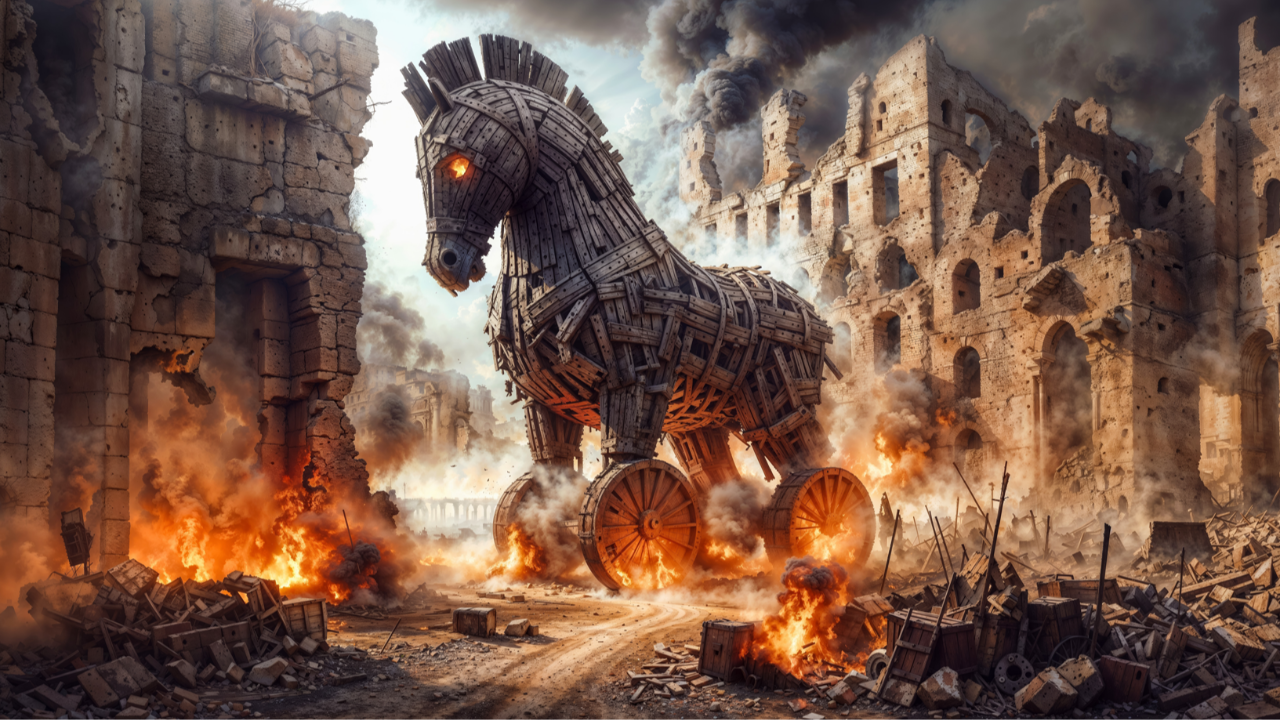
He ordered a giant wooden horse. Hollow inside. Epeius, the finest carpenter among them, built it. And inside hid the deadliest warriors in Greece, led by Odysseus himself.
Then the Greeks did something unexpected. They pretended to withdraw. They burned their camp. Their ships vanished over the horizon. They left the horse on the beach, apparently abandoned, an offering to Athena to secure their voyage home.
The Trojans came out from behind their walls for the first time in a decade. They looked at the horse.
And here comes the part everyone forgets.
There were warnings.
Cassandra, the prophetess, screamed that it was a trap. Nobody listened. She was mad. She was an alarmist. She saw danger where there was none.
Laocoön, the priest, hurled his spear at the horse and spoke the words that would echo for two thousand years: I fear the Greeks, even when they bring gifts. Not long after, sea serpents killed him and his sons. The Trojans read it as divine punishment for doubting the gift.
A Greek named Sinon, left behind on purpose, convinced them the horse was sacred, that bringing it inside would secure the protection of the gods.
And then the Trojans did something extraordinary.
They broke their own walls.
The horse was too large to pass through the gates. So the Trojans, with their own hands, tore down part of the defenses that had held for ten years. They destroyed what no Greek army had been able to destroy.
That night, while Troy celebrated its victory, the warriors came out of the horse. They opened the gates from the inside. The Greek army, which had never really left, walked in.
Troy fell in a single night. Not through the strength of its attackers, but through the blindness of its defenders.
A note on the source, because it matters. The horse barely appears in Homer. The version we all carry, with Cassandra, with Laocoön, with the serpents and Sinon, comes mostly from Virgil's Aeneid, written around two thousand years ago. The war it describes is older. The telling is not. Rome inherited the story and made it a warning about the gifts that empires accept.
The Pattern That Repeats
The story is ancient. It has never stopped happening.
The pattern is always the same.
First, direct force fails. The walls hold. The resistance is too strong.
Second, something is designed that looks like a gift. Something desirable. Something the target will carry inside its own defenses, of its own free will.
Third, those who warn are silenced, ridiculed, or ignored. They are alarmists. They are paranoid. They are behind the times.
Fourth, the target does not merely accept the gift. It dismantles its own defenses to receive it.
Fifth, once inside, what was hidden emerges and opens the gates to everything else.
This pattern has repeated in empires, in companies, in cultures, in individual minds. And it is happening now, at global scale, in real time, in front of us.
The Horse That Tasted Like Coffee
It was the 1970s. Nestlé had carried its instant coffee into markets across the world. Japan was the one that would not move.
The version of this story that circulates says the Japanese did not drink coffee at all. That version is cleaner. It is also wrong, and the truth is more useful.
Coffee had been in Japan for decades. The kissaten, the Japanese coffee house, had been part of urban life since before the war. Canned coffee launched in 1969. Postwar Western influence, office routines, and vending machines on nearly every corner were already moving the ground, slowly, without anyone directing it.
What Japan did not have was memory.
Tea was not a beverage there. It was identity. It was ritual. It was how families connected, how ceremonies were marked, how the important moments announced themselves. Tea meant warmth, home, belonging. Tea was the cultural wall, built over a thousand years.
Coffee, by contrast, meant nothing. A bitter foreign liquid with no history, no emotional connection, no code.
This is not the same everywhere. For those of us who grew up in Colombia, Cuba, Nicaragua, in any coffee-growing country in Latin America, the story is entirely different. We grew up with the smell of coffee filling the house at dawn. We grew up sitting beside our grandparents while they held a steaming cup and told stories. Coffee with sweet bread was a Sunday ritual, an after-lunch conversation, a moment of connection across generations. Our emotional code around coffee was written before we could walk.
Japan had none of that. Coffee was as foreign to their inner experience as the tea ceremony would be to someone who had never seen one. No memory. No nostalgia. No code.
So Nestlé had a category that was slowly growing and no emotional foothold inside it. Coffee was expanding in Japan without Nescafé expanding with it.
They tried everything. Mass advertising. Sophisticated campaigns. Discounts. Promotions. The Japanese tried the coffee, shrugged, and went back to tea.
Direct force was not working.
So in 1975 they hired a French child psychiatrist named Clotaire Rapaille. A student of the unconscious who understood something the marketing executives could not see: habits are not sold. They are built.
Rapaille told them the problem was not the coffee. The problem was that coffee had no imprint in the Japanese psyche. It was not connected to any childhood memory, any sense of safety, any experience of love.
And then he designed the horse.
Building the Horse
Nestlé did not try to sell coffee to Japanese adults.
They went for the children.
They created coffee-flavored desserts. Coffee-flavored candy. Coffee-flavored ice cream. Products designed so that Japanese children would associate the taste of coffee with something already coded positively: sweetness, pleasure, warmth, happy moments.
They were not selling coffee. They were not trying to convince anyone of anything.
They were building an imprint. Planting an emotional code. Creating memories the children would never know had been designed.
The gift looked harmless. It was only candy. Only sweets. Only desserts that made children happy. Who could object to that?
Japanese parents, without knowing it, were removing bricks from a wall. Every coffee-flavored sweet bought for a child was one more stone out of the cultural defenses that had held for generations.
And the horse went in.
The Night Troy Fell
Years passed. The children grew up.
When those children entered the workforce, when they became the adults making purchasing decisions, something happened: coffee was no longer a foreign taste. It was a familiar one. It carried something warm they could not name.
They did not know why they liked it. They could not trace the feeling back to a candy they had eaten at six years old.
It was nostalgia for a designed childhood.
Nestlé pushed instant coffee again. And this time it moved.
Then they kept going, layer over layer. J-Pop figures. Anime. Year after year, weaving coffee further into the emotional landscape of the country.
Today, coffee sits second only to tea among the beverages Japanese consumers drink regularly, and in 2023 Japan ranked fourth in the world in total coffee consumption, at roughly 464,000 metric tons. One market study puts the Japanese coffee market above thirty-five billion dollars.
Here is the part worth being precise about, because the dramatic version has been repeated so often that it has replaced the real one.
Nestlé did not rewrite the memory of a nation from nothing. That claim survives because it is a better story. What actually happened is more interesting and far more replicable: they found a shift already underway and gave it the one thing it was missing. A childhood.
The horse did not start the war either. It arrived in the tenth year, when Troy was already exhausted, and it finished something that was already ending.
That is what these strategies actually do. They rarely create the current. They find it, and they steer it.
The Patience of the Predator
There is something in this story that most people pass over. Something that reveals what these strategies actually are.
Time was not a problem.
Nestlé did not need results next quarter. They were not thinking about the annual report. They were thinking in decades. They knew that the children eating coffee candy in 1975 would be the adults buying instant coffee in 1990. And they were willing to wait.
Odysseus waited inside the horse all night while the Trojans celebrated. He was in no hurry. He knew the moment would come.
This is what separates genuinely transformative strategy from ordinary tactics: the capacity to think on time scales the ordinary mind cannot hold.
Coldly calculated. No emotion. No hurry. None of the anxiety of the immediate result. Only the mathematical certainty that if you plant the right seeds in the right ground, the harvest arrives. Whether it takes five years or fifty.
Like a cancer, which does not need you to notice it in order to keep working.
Social engineering operates the same way. It does not need to be seen coming. It works better unseen. Every year undetected is another layer of normalization. Every generation is a point of no return.
The Digital Trojan Horse
If a corporation could do this with coffee and candy in the 1970s, what could be done today with algorithms, screens, and unlimited access to the minds of a nation's children?
Consider one fact, and consider it carefully, because the version of this argument that circulates online is mostly exaggeration and the real version is worse.
China regulates by law how long minors may spend online. The domestic version of one major short-video platform operates a youth mode with a hard daily time limit for children. The export version of that same platform, the one on your child's phone, carries no comparable legal obligation anywhere it operates.
That is not a content conspiracy. It is a regulatory asymmetry, and it is documented.
One country decided its own children needed protection from a product it built. It did not extend that judgment to anyone else's children. It did not have to.
And like Nestlé, no one involved needs the answer this quarter.
What kind of adults will be produced by children who spend six hours a day inside systems designed to capture attention rather than develop capacity? What kind of society will they build when sustained focus was never trained? What kind of citizens will they be when critical thinking never had the empty hours it requires in order to form?
The people who build these systems are not waiting on a quarterly report. They are thinking about 2040. About 2050. About the moment the generation raised inside these platforms becomes the generation making the decisions.
Meanwhile, parents buy the devices. Pay the subscriptions. Defend the platforms when someone raises a question.
Exactly like Trojans breaking their own walls.
The Egregore: The Horse That Thinks
Here the story goes deeper.
The original Trojan horse was wood. It was an object. It needed warriors inside in order to act.
The modern one is different. It is alive.
In the esoteric traditions there is a concept called the egregore: a collective psychic entity born from the sustained repetition of thoughts, emotions, beliefs, and rituals shared by a group of people.
When an idea is repeated consistently, charged with intense emotion, socially validated, and ritualized, it crosses a threshold. It acquires a kind of autonomy. It begins to think through the people who feed it.
Call it what you like. Ideology, memetics, collective inertia, the water we swim in. The name matters less than the behavior, and the behavior is observable: past a certain density of belief, ideas stop needing individual hosts to defend them. They defend themselves through anyone available.
The egregore is the modern Trojan horse.
But unlike the wooden one, it does not need warriors inside. It turns the inhabitants of the city into its warriors.
Once installed, once it has been fed by enough collective attention, it begins to operate through the people who carry it. It thinks through them. It feels through them. It defends its existence through them.
Have you noticed how intelligent people defend ideas that clearly do not benefit them? Ideas they do not fully understand? Ideas that actively harm them?
That is an egregore running. Those people are not thinking. They are being thought.
The horse no longer needs to open. The warriors are the Trojans themselves, reprogrammed without knowing it.
The Egregores We Feed Without Knowing
While we were distracted surviving, while we ran on the wheel trying to pay the bills, while we navigated economies designed to keep us perpetually anxious and perpetually consuming, something was feeding on our collective attention.
The egregore of scarcity. Millions of people, every day, believing there is not enough, that they are not enough. That repeated belief creates a structure that requires you to keep believing in scarcity in order to persist. It needs you hungry. It needs you dissatisfied. And you feed it every time you feel that it does not add up.
The egregore of political powerlessness. Generations convinced that their vote does not matter, that every government is the same, that the system cannot be changed. This one was planted patiently and cultivated over decades. Those who benefit from a system learn that they do not need to repress people. They only need to convince them that resistance is pointless. And now that thought thinks itself, repeats itself, defends itself.
The egregore of the external savior. Institutions that taught us to wait for someone to come and rescue us. Gurus, messianic politicians, ideologies that promise paradise if you only believe enough, follow enough, wait enough. While we wait to be saved, we never develop the muscle of saving ourselves. And that suits someone.
The egregore of division. The specific line does not matter. Any line will do, because the function is the same: while we fight each other, we do not look up. We do not ask who profits from the conflict. We do not notice that the fight itself is the product, and that outrage is the most efficiently monetized emotion ever discovered.
Each of these was seeded the way Nestlé seeded coffee in Japan. With patience. With strategy. With the coldness of someone who knows time is on their side. And now they are so much a part of the landscape that we no longer see them. They are the water we swim in. The air we breathe.
What We Lost Without Noticing
There was a time, not long ago, when children left the house in the morning and did not come back until dark.
We ran. Literally ran, with no destination and no purpose, for the pleasure of feeling wind and a body in motion. We scraped our knees and kept playing. We built entire worlds out of sticks, stones, mud, imagination. There was no tutorial telling us how. We had to invent.
We fought with our friends and learned to repair it. We were bored, and out of that boredom came invention. We looked at clouds and saw dragons, castles, faces. The mind had room to wander, to create, to process.
We socialized face to face. We learned to read expressions, tones, silences. We knew when someone was sad without them posting it. We built tolerance for frustration, because real life has no skip button.
All of that went. Not at once. Gradually. So gradually that almost no one noticed.
Year by year. Generation by generation.
And we, like Trojans celebrating around the horse, did not see what was happening.
We traded childhood for quiet. We broke the walls with our own hands.
The Cassandras of Our Era
Remember Cassandra. The prophetess who warned about the horse and was ignored because she was mad.
Remember Laocoön. The priest who said he feared the Greeks even bearing gifts, and was destroyed by serpents the Trojans read as punishment for his doubt.
There are Cassandras now. Parents who limit screen time and are treated as extremists. Researchers who document harm and are dismissed as alarmists. Voices that name the pattern and are labeled paranoid.
The modern serpents do not kill physically. They kill socially. They destroy reputations. They silence through ridicule, through exclusion, through the quiet withdrawal of belonging.
And meanwhile the Sinons keep working. The platform spokespeople. The experts who assure us that everything is fine, that the benefits outweigh the risks, that there is nothing to worry about.
It is only entertainment. It is only social connection. It is only technology. Do not be so old-fashioned.
The Collective Torpor
Here is what unsettles me most. Most of us feel that something is wrong, that something does not add up, that the world should not work this way. And we are so exhausted, so overwhelmed, so busy surviving the day, that we have no energy left to stop and look.
That is not incidental.
An exhausted population is a compliant one. An indebted population is an obedient one. An entertained population does not ask questions. A divided population cannot organize.
Keep us tired. Keep us busy. Keep us fighting each other. And the thing advances without anyone stopping it.
The Trojans were exhausted too. Ten years of war. When they saw the Greeks leave, when they saw the gift, they were so tired of fighting that they wanted to believe it was over. They wanted to celebrate. They wanted to rest.
Exhaustion is not a side effect. It is part of the architecture.
The Way Back
The horse is already inside. That we cannot change.
But unlike the Trojans, we can wake before the night is over. We can see the warriors before they reach the gates. We can act.
This is not about destroying the screens or returning to 1985. It is about balance. About recovering what we lost without surrendering what we gained.
And here is the beautiful irony: the same strategies they use are available to us. If they think in decades, so can we. If they plant seeds in the minds of children, so can we. If they have patience, we can have more.
But first we have to wake up. And waking up requires practice.
Observe. Observation is the first act of freedom. Cassandra saw because she watched. Observe without reacting. Notice how each piece of content you consume makes you feel. Ask whose thoughts you are actually thinking. The next time you feel something intense about something on a screen, stop. Look at it. Does this serve my life, or is it using me? Is this my thought, or is something thinking through me? What grows in the dark does not survive being looked at directly.
Presence. Egregores can only operate while you are on automatic. Presence, being here now, is the most powerful antidote available. Practice deliberate moments of it: your feet on the floor, your breathing, the sounds around you. No judgment, no analysis. Just being there. From that place, automatic reactions lose their grip. Installed programs stop running. The horse cannot operate while you are awake.
Question. Laocoön questioned. He paid for it, and he was right. Question not from paranoia but from genuine curiosity. For every belief you hold strongly, ask: where did this come from? Who benefits from my believing it? Is it actually mine, or did I absorb it without noticing? Is it a gift, or is it a horse? Questioning is not doubting everything. It is verifying what belongs to you and what was installed.
Intentional silence. Egregores need constant noise. Silence weakens them. Practice periods of digital silence: no screens, no stimulus, no input. At first it will be uncomfortable, almost painful. That discomfort is the dependency protesting. Persist. In the silence, your own voice begins to surface.
Real connection. Come back to the table. To conversations with no objective. To looking at each other. To hugs that last longer than three seconds. To being with people while no one is holding a screen. Genuine human connection is a field of force against anything that works by isolating us. It is rebuilding the walls we tore down.
Nature. Go outside. Touch ground. Look at trees. Feel sun and wind. Nature has a frequency that recalibrates an overloaded nervous system, and this is not hippie metaphor, there is research behind it. The Japanese call it shinrin-yoku, forest bathing. Studies have found that twenty to thirty minutes of contact with nature measurably lowers cortisol and restores the capacity for attention. It is resetting the operating system to its original configuration.
Create instead of consume. Every hour consuming content is an hour feeding someone else's structure. Every hour creating is an hour building your own. Write, draw, cook, build, plant, compose. It does not matter what. It does not matter whether it is good. The act of creating returns you to the center of your own life. It turns you from consumer into generator. From inhabitant of the horse into builder of your own structures.
Physical movement. The body stores what we consume. It shows up as tension, anxiety, exhaustion with no obvious cause. Movement, any movement, processes it. Walk, dance, stretch, run. Move the body and you move what has been sitting still. Come back to inhabiting yourself. The body is your territory. Take it back.
Choose your inputs. You are what you consume, not only in food but in information. Run an honest audit. What accounts do you follow? What news do you take in? What conversations do you keep returning to? Every input is a seed. If they can plant seeds in your mind without your consent, you can consciously choose what grows there. Stop wheeling horses into your own city.
Your own rituals. These structures are strengthened by ritual. So build your own. A morning ritual that centers you before the world pulls. An evening ritual that closes the day with intention. It can be as simple as three conscious breaths, a cup of coffee in silence, yes, like our grandparents, or writing down three things you are grateful for. What matters is consistency and intention. You are writing your own emotional code. You are planting your own seeds.
Strategic patience. If they think in generations, so can we. Do not be discouraged when change is not immediate. Do not abandon it because a week produced nothing visible. Every conscious action counts. Every child given back an hour of unstructured play is a different seed planted. Every deep conversation is an antidote. Every wall rebuilt is a defense restored. Think long. Be patient. The same patience they have, in the service of life instead.
The Call
We have fed structures that weaken us. Not out of malice. Out of unconsciousness. Out of distraction. Out of exhaustion. Out of the collective hypnosis of an era built to keep us asleep and consuming.
We have broken our own walls to bring in horses that promised gifts.
We have ignored the Cassandras and applauded the Sinons.
But unconsciousness is no longer an excuse. You already know too much.
Every minute of attention is an offering. To which altar are you carrying it?
Every repeated thought is a brick. What building are you putting up?
Every amplified emotion is fuel. What fire are you feeding?
You cannot not participate. There is no neutral. Your attention goes somewhere, always. Your energy feeds something, always. The only question is whether you do it asleep or awake.
The children of this generation will be the adults who inherit this world. The codes being installed in their minds now will determine what kind of society they build. What capacities they will have. What values they will hold. What walls they will defend or destroy.
What are we handing them?
What are we taking from them while no one is watching?
The Choice
I am not asking you to believe anything. I am asking you to look. To step out of the trance for a moment and see, really see, what has been normalized. What we have accepted without question. What we have handed over without noticing. What walls we have torn down with our own hands.
And then to decide, consciously, deliberately, what you want to feed with the time you have left.
Because the horse is already inside. The warriors are already coming out.
But it is not morning yet. The gates are not all open. There is still time.
Those who know the horse is inside have an advantage the sleeping Trojans never had.
They can see it.
And what is seen can be faced. What is named can be transformed. What is understood loses its absolute power over you.
This is the moment to wake. Not tomorrow. Not when you have more time. Now.
The war for the future is not fought on battlefields. It is fought in the mind of every child. In every minute of attention. In every emotional code that is planted or protected. In every wall torn down or rebuilt. In every seed we choose to plant, or allow someone else to plant for us.
The horse is inside.
The warriors are coming out.
It is not yet dawn.
What will you do before the sun comes up?
Myriam V.