Kyoto, and the love that was never spoken out loud
There are loves that are not born in this life. They wake up in it.
I know because I have stood in front of someone and felt centuries fold into a single glance. Because I have recognized hands that held mine somewhere else, in a life I could not have described a minute earlier.
This is not philosophy. It is memory, and I will not defend it as anything else.
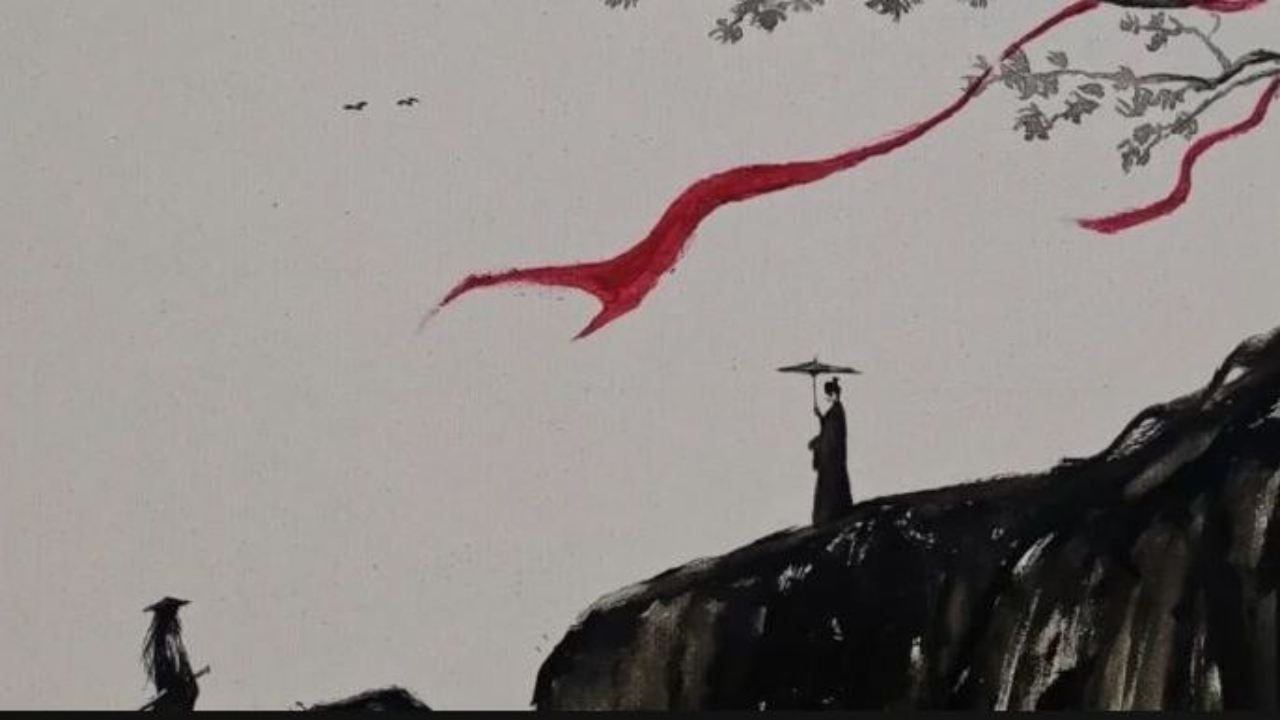
It is also one chapter of several, and this one was written in a country where a single brushstroke could mean everything, and where love was not spoken but held in the space between two people who dared to actually see each other.
The geisha
I was born into folds of silk and the sound of a shamisen.
My steps were prayers painted onto wooden floors. My voice was water that had learned to speak without words. My face was trained into serenity and hid weather that no poem could have contained.
I lived between beauty and renunciation, between falling petals and inherited duty, understanding that what I did was not entertainment. It was a task: to keep some grace alive in a world that was in the process of burning.
I danced with a fan that held every wind I was not permitted to release. I poured tea with hands that trembled only when no one was watching. I smiled at men who saw the surface and never suspected that underneath the white powder there was a woman dreaming, every night, of something she could not name.
And then he came.
The samurai
He was a warrior made of wind and silence.
His sword did not only cut air. It cut illusion. Every movement was a meditation and every fight a prayer to impermanence. He had been trained in Bushidō, which teaches a man to die daily so that he can be genuinely alive, and he had made his peace with death more times than he could count.
He was afraid of nothing.
Until he walked into a room where I was pouring tea with the composure of a moon reflected in still water.
I did not look up. I did not have to. I felt him arrive the way you feel weather change, the way the air goes strange in the minute before rain.
And when I finally raised my eyes I understood something: that there are deaths gentler than anything a blade can offer, and that one of them is the surrender to what your soul recognizes as home.
He looked at me the way you contemplate a flame you have been told not to touch. I heard him the way you hear a melody you do not dare to dance to.
Neither of us said anything.
What we felt did not fit inside language. It was an unwritten haiku. Three breaths held in the air, saying everything by refusing to say it.
The war that was never declared
Every encounter after that first one was its own battlefield.
Duty against wanting. Form against essence.
He belonged to his lord, his sword, and a code that did not include this. I belonged to my house, my art, and my part in the careful theater by which women in that world survived.
We could not speak of it. Most days we could barely look at each other without the room igniting.
So we loved in silence.
In the way he arranged his body when I danced, turning toward me the way a flower turns.
In the way I poured his tea, letting my sleeve brush the air near his hand without ever touching it.
In the poems we did not write and both understood, the haikus that existed only in the space between our breathing.
Under the same sky, I danced with a fan and he meditated with a sword, and both of us were looking for the same stillness in the middle of the same storm.
The red line
Then destiny drew its line, the way it does, without consulting anyone.
He was called to war.
I watched him leave from behind a screen, unable to speak and unable to weep, my face as still as the mask I had spent years learning to wear.
I wanted to run. To take off the silk and follow him. To stand next to him with nothing but this as a weapon.
The world does not allow that. The world rarely allows what the heart most needs.
I was sold to another tea house before he came back. We never saw each other again in that life.
Except in sleep.
Night after night I walked with him across a bamboo bridge that had no other side. Mist all around, soft as the silk I wore and sharp as the sword he carried. We spoke without speaking. We touched without touching. And every morning I woke with the ache of something that had no resolution, no ending, no final line.
He told me once, inside one of those dreams, that he sometimes woke to the sound of a fan opening in the dark.
I told him that I fell asleep feeling steel against my skin. Soft as a feather. Precise as a poem.
And we left that world carrying an oath neither of us had said out loud:
We will meet again. When the sword remembers the dance. When the dance embraces the blade.
Before, and before that
Kyoto was not the first time.
There was a river, and a woman who could not bear the waiting, and a green stone thrown into sacred water. There was snow, and pines, and runes cast again and again that kept returning the same answer: not this life. Not this shore.
I have written elsewhere about the river, and what it cost, and what it eventually taught.
What matters here is only the shape.
The same recognition. The same impossibility. The same promise passed across the veil: not yet, but soon.
And him leaving, every time. This soul that carries fire and keeps walking into it.
And me waiting, every time. This heart that burns and does not know how to do it quietly.
What is different
And then, under other skies, wearing other names, we found each other again.
No war this time. No screen. No social chasm doing the work that neither of us would have chosen.
He still has the gaze that goes through the illusion. I still have whatever it is that holds grace together in the middle of chaos.
But something has changed, and it is not the circumstances.
This time I did not throw my heart into any river.
This time I did not stand behind a screen and let the world decide.
Because the lesson finally arrived, and it took several lifetimes and it is embarrassingly simple: love does not grasp. Love does not ask the gods to intervene in something it cannot see the whole of. Love trusts, which is not passivity and is considerably harder than the alternative.
The last haiku
They say that when two souls love without possession, nothing can permanently separate them. That they are brought back into the same room until the loving stops being wanting and becomes something clearer.
I do not know whether that is true as a law.
I know it has been true as an experience, and I have stopped requiring those to be the same thing.
The sword has remembered the dance. The dance has embraced the blade.
The stone came back, not as loss but as something I can hold without gripping. The fan I carried in Kyoto still moves in me, stirring the same air. The runes still say what they said, and now it reads differently.
What happens next, I do not know. The brush is still moving. The ink has not dried.
But the bridge we walked in dreams has touched ground.
Three breaths. Seventeen syllables. One thing that took centuries to learn:
Sword meets silk at last,
the river returns what was lost,
two birds find their sky.
Myriam V.