A sign is not wrong because it takes months to finish arriving
On the last night of 2022 I broke an egg into a glass of water.
It is a New Year tradition where I come from. You break the egg at midnight, let it settle, and read the shapes that rise from the bottom. Some people do it to guess what the year will bring. I did it that night for something smaller: to receive a glimpse. Not an answer. Just a direction.
When I looked at the glass, two things had formed.
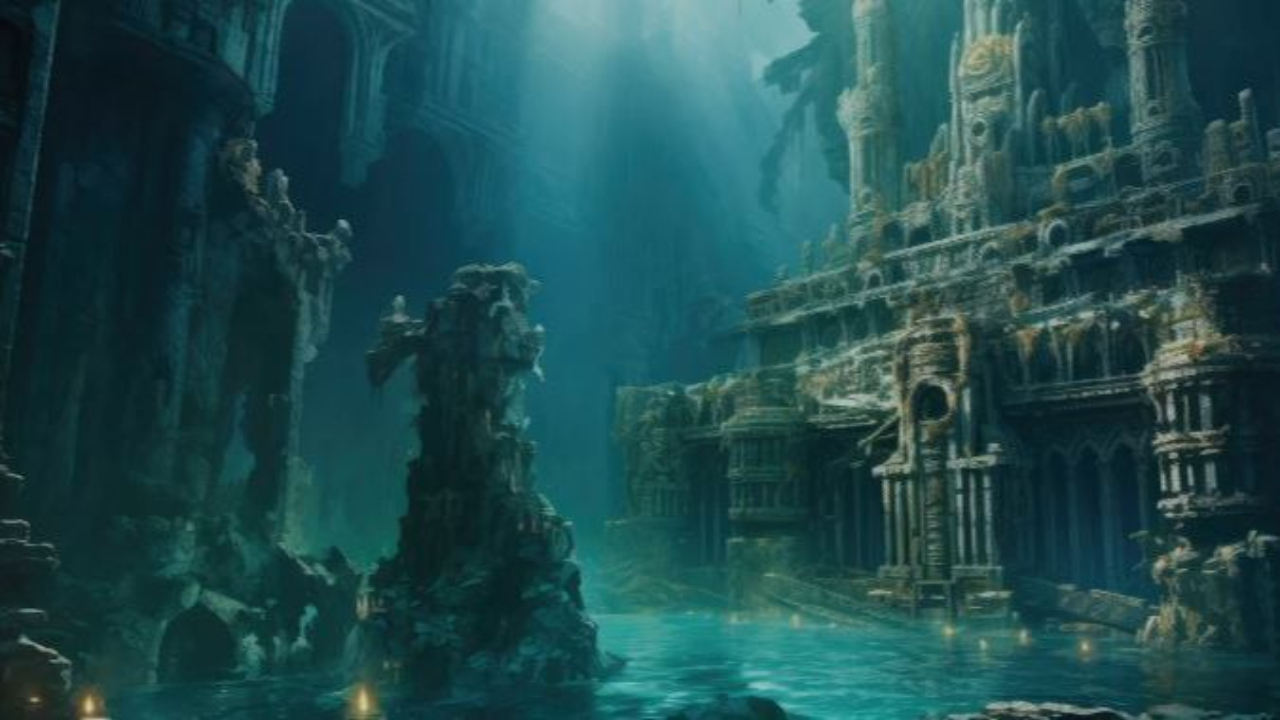
Something like a palace, or a castle, with the shape of a submerged city rising from the bottom.
And a trident.
My mind did the arithmetic in about two seconds. Trident. Poseidon. Greece.
I smiled and said out loud: Santorini, I'll see you soon.
Then I did what I do when something feels clear. I gave it form. I looked up the full moons of 2023 and found one in early June, in Sagittarius, which felt almost too appropriate. The traveler. The philosopher. The one who crosses borders looking for meaning.
The trip was decided. In my imagination I had already been there.
Then Greece closed
On the twenty eighth of February I finally sat down to buy the ticket.
I opened the browser and the first thing on the screen was the news of a catastrophic train collision in Greece. Fifty seven people dead.
I sat looking at it, and something in me said, immediately and without deliberation: not there.
Not as a conclusion. As a certainty, which is a different thing and arrives faster than thought.
And I was crushed, because I had already made the trip inside my head. The white houses. The moon coming up enormous over the Aegean, and the whole sea holding it.
How could it not be Greece? I had seen the trident.
Where the palace actually was
Months later I was in Egypt, on a boat approaching the temple of Isis, and something began to come apart in the best possible way.
I had been so taken with the trident that I had almost forgotten the other image. The palace.
When I got home I started reading about what Egypt had opened, and I found Antirhodos.
Off the coast of Alexandria, under the water of what was once the Royal Harbour, lie the remains of the Ptolemaic royal complex. Palaces. Columns. Statues. Sphinxes. An actual submerged city, mapped by underwater archaeology, sitting there in the Mediterranean the entire time I was looking at Greece.
The palace had not been Greek.
It had been Egyptian, and it had been real, and it had been waiting for me to arrive at it by a route I would never have chosen.
And that is when I understood something I have not stopped thinking about since.
The sign was not wrong. I was trying to read, in a single image, a story that needed most of a year to unfold.
Which changes what a sign is
That distinction turns out to matter enormously, and not only for me.
We tend to treat a sign as a message: a compressed instruction that should decode cleanly, right now, into something actionable. And when it does not decode, or when the decoding turns out wrong, we conclude that the sign was false or that we imagined it.
But consider the other possibility.
That some things arrive whole and are understood in pieces. That the image comes first and the meaning is assembled afterward, over months, by living. That what looks like an error in the reading is often just the reading happening too early.
I said Greece because Greece was the only door my mind had available at that moment. It was not a mistake. It was the first thing a symbol could mean to someone who had not yet been where she needed to go.
The palace found Egypt. It just took a year.
Sunken cities
I want to sit for a moment with why a drowned palace does anything to us at all.
Because it does. There is something in that image, across cultures and across centuries, that people keep returning to. A city under water. Something magnificent that was and is not, still down there, intact, unreachable.
The two most famous versions are worth being honest about.
Atlantis first appears in two dialogues by Plato, in the fourth century before our era. Most scholars read it as his own construction: a cautionary tale about a naval power that grew arrogant, written by a philosopher arguing with the Athens of his own time.
Which means the story was already a warning about power without wisdom on the day it was written. It was never a report. It was a lesson wearing the costume of history, and it has done its job so well that people have been hunting for its coordinates for two thousand four hundred years.
Lemuria has a stranger origin, and I find it more moving.
In 1864 a zoologist proposed a sunken landmass to explain why lemurs appear in Madagascar and in India but not in the intervening parts of Africa. It was a serious scientific hypothesis for its moment. Then plate tectonics arrived, explained the distribution properly, and made the continent unnecessary.
And here is what happened next. Theosophy picked it up, and the vanished landmass became a lost spiritual civilization, a first humanity, a crystalline age of unity.
A continent invented to account for some primates became the mother of the human soul.
I am not going to pretend that is history. But I do not think it is nothing, either.
Because look at what it says about us: that when science vacated the continent, something in us moved in immediately. We needed a lost origin badly enough that the moment one became available, we furnished it.
What the drowned city is doing
So no, I do not believe Lemuria existed in the way the stories describe.
I believe the longing is real, and I think the longing is older than either story.
Every culture I know of carries some version of it. A time before the separation. A place where things were whole and something broke. Eden. The golden age. The world before the flood, and almost every civilization near water has a flood.
That recurrence is a fact, whatever its cause. And the simplest explanation is also the most interesting one: human beings arrive already carrying the sense of having lost something they cannot name, and every culture builds it a location.
Which does not make the location fictional in the way that matters.
It makes it a map of an interior.
And that is exactly what my glass of water was doing, so I am not in a position to be condescending about it. I saw a palace under water and assigned it to Greece because Greece was available. Humanity saw something missing and assigned it to a continent.
Same operation. The difference is only how long we have been waiting for the meaning to finish arriving.
And what the two of them teach
Read as parable rather than as chronicle, the two cities say opposite and complementary things, and this is why they have lasted.
Lemuria is wisdom that never grounded. Consciousness so refined it lost its hold on the material, so unified it forgot to build anything that could stand. It does not fall dramatically. It dissolves, which is what happens to spirituality with no relationship to ordinary reality: it drifts, and then one day it is not there.
Atlantis is power that kept everything except the heart. Capability without ethics, technology without the wisdom to aim it, knowledge turned toward dominion. That one does not dissolve. That one detonates.
Between the two of them there is a description of exactly the choice in front of us, and it was written by people who had never seen a machine.
That is not because they were prophetic.
It is because the failure modes of a civilization are not that numerous, and they had already watched both.
Three who weave
Now the part that is not myth, and that I find the most beautiful.
Across cultures that had no contact with each other, the same figure appears: not one being who governs fate, but three, and almost always women, and almost always working with thread.
In Greece, the Moirai. Clotho spins it. Lachesis measures it. Atropos cuts it at the exact moment. And the Greeks made a claim about them that I have never gotten over: that not even the gods had authority over the three. Zeus himself was subject to what they wove.
In the Norse world, the Norns at the roots of the world tree, pouring water on it daily so it does not rot. Urðr, what has become. Verðandi, what is becoming. Skuld, what is owed or what shall be. They carve the fates of gods into the trunk, and the gods do not object.
In Egypt, the arrangement is different and the structure holds. Isis, who gathers what has been scattered and puts it back together. Nephthys, who accompanies the passage between one state and the next. Hathor, who receives with music, because joy is also a form of order.
Three cultures. One who begins, one who sustains or measures, one who completes or transforms.
I want to be careful about what I claim here, because the tempting version of this argument is the weak one.
I am not saying these are three names for one goddess. They are not. The Moirai are not the Norns, and Isis is a genuinely different order of figure from either. Flattening them into a single archetype disrespects three traditions in order to make one point.
What I notice is narrower and stands up better.
Human beings, thinking independently, kept concluding that fate has three phases and that no single force governs it.
Not one. Three. Which means beginning, duration and ending are separate operations, and the same power does not run all three.
Why three is the interesting number
Because it is the structure of anything that unfolds in time.
Something starts. It lasts a certain length. It ends, and the ending is not a failure of the starting.
We are terrible at holding all three at once. When something begins we act as though it will not end. When something is ending we act as though it was never worth beginning. And the middle, the duration, the part where nothing is decided and you simply keep going, is the part almost nobody has patience for.
Which brings me back to the glass.
The palace was spun on the last night of 2022. It was measured across a year of countries and closed doors and things that did not go as planned. And it was completed somewhere under the Mediterranean, in a city nobody has walked through in two thousand years.
I only wanted to be told where I was going.
What I got was a demonstration of how meaning actually behaves, which is nothing like being told.
The thread
So here is what I think the sacred thread is, and it is more modest than the phrase suggests.
It is not a golden filament connecting all souls, though I am not going to argue with anyone who experiences it that way.
It is this: that a true thing can arrive before there is anywhere to put it.
That an image can be entirely accurate and completely unreadable at the same time. That a longing can be older than any explanation offered for it. That a story told to warn a Greek city can still be doing work twenty four centuries later.
Nothing gets lost, exactly. It goes under the water and waits, and it is retrieved by whoever is finally standing in the right place.
Alexandria sank and stayed there, entire, for two thousand years, until people learned to dive with equipment and lights.
The city was never gone. We were the ones who were not ready.
I asked for a glimpse and I got one.
I read it wrong, or rather, I read the only part of it I was standing close enough to see.
And the rest of it took a year to say what it was saying, and I would not have believed the answer on the first night, which is probably why I was not given it.
The thread does not break.
It just takes longer than we do.
Myriam V.